iPhone Duo Hinge Protection Case: Best Options & Buying Guide for 2026
Cover the spine, link the halves, or leave the hinge alone. What each one protects, what it costs, and how to choose between them.
TL;DR
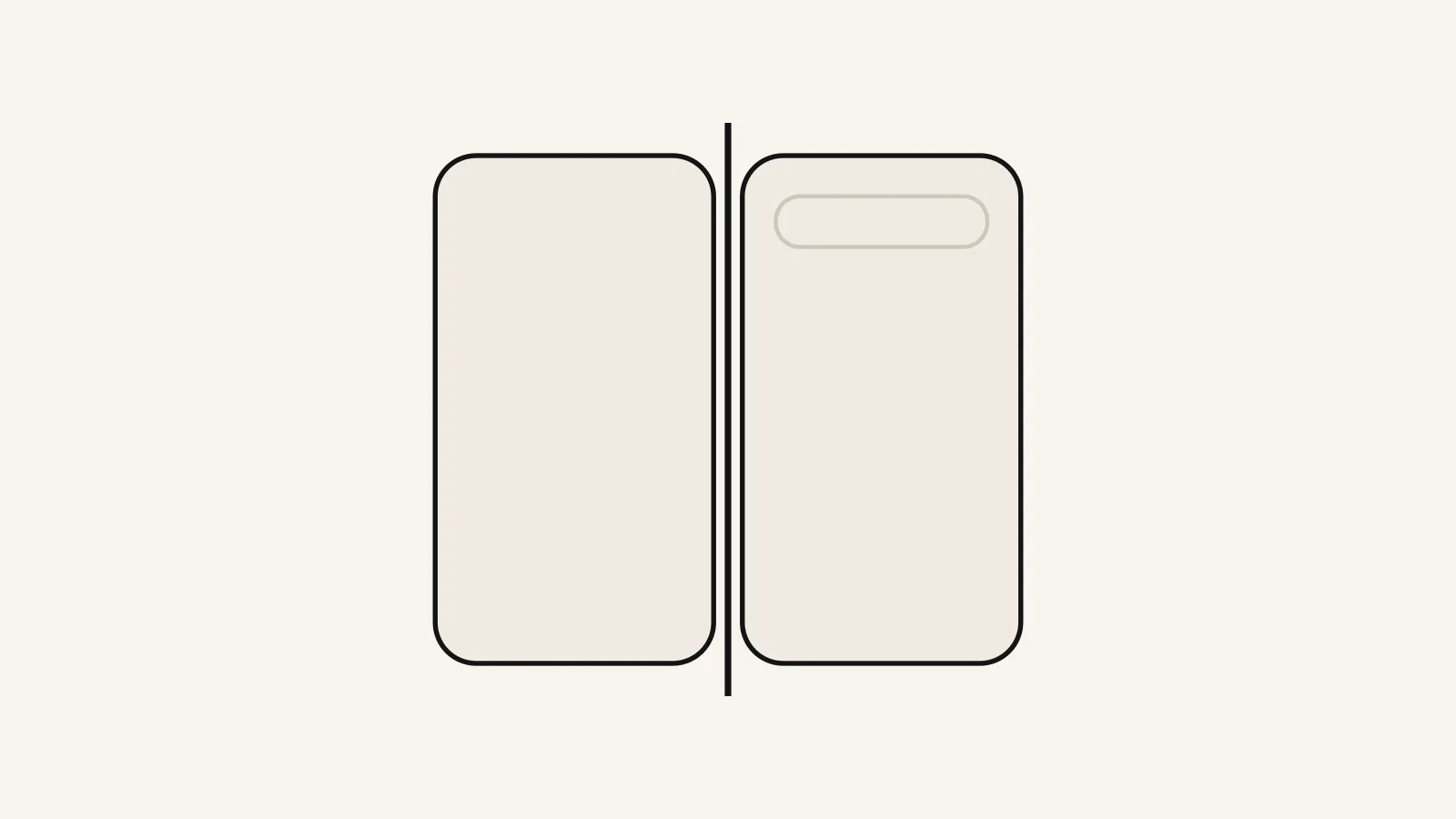
An iPhone Duo hinge protection case does one of three things: it covers the spine, it links the two halves with a hinge piece, or it leaves the hinge free and protects the halves on either side. Covering the hinge guards its titanium cover against scratches, at a cost in thickness and, in one maker's own words, accessory compatibility. WRAPDUO leaves the hinge free by design, and this guide says when a cover is the better choice.
What does an iPhone Duo hinge protection case actually protect?
An iPhone Duo hinge protection case protects the spine of the phone: the titanium hinge cover that runs along the fold and shows on the outside when the phone is closed. Some cases cover that spine completely, some link the two halves with a piece that moves over it, and some leave it free and protect only the halves on either side. All three are sold as protection. They protect different things.
The hinge is the most talked-about part of any folding phone, so it is natural to want it covered. Before deciding, it helps to know what the hinge is, what a cover does to it, and what a cover costs you. This guide goes through each in turn, using what Apple says about its own hinge and what case makers say about their own designs.
One practical note first. The iPhone Duo goes on sale on Friday 23 October, with pre-orders from 16 October (Apple Newsroom). Everything below is about design, because that can be judged now; how any particular case wears over months is something nobody can report yet.
What is the iPhone Duo hinge made of?
Titanium, and a great deal of engineering underneath it. Apple describes the iPhone Duo as “crafted from grade 5 titanium for incredible strength, with an enclosure that has an elegant mirror-polished finish and a 3D-printed hinge cover with a contrasting micro-blasted finish” (Apple Newsroom). Its specifications add that the phone uses “100% recycled titanium in the 3D‑printed hinge cover” (Apple, specifications).
Beneath the cover is the mechanism itself. Apple says the hinge uses “more than 100 components to precisely control opening and closing and support the center of the display” (Apple Newsroom), and that it “is designed to open and close with smooth, balanced resistance for long-lasting reliability” (Apple, iPhone Duo).
Two things follow for anyone choosing a case. The part a hinge cover would protect is the titanium cover, a finished exterior surface rather than exposed machinery. And the mechanism beneath it is designed to move freely and evenly, which is exactly the property a badly designed case could spoil. What a folding hinge actually tolerates looks at what does and does not harm a hinge in ordinary use.
What are the three ways a case can treat the hinge?
Leave it free, link across it, or cover it. Every iPhone Duo case announced so far takes one of these three approaches at the fold, and the approach decides most of what the case will be like to live with.
| Case option at the hinge | What it protects | What it costs you | Closes on the phone’s own magnets? | Suits |
|---|---|---|---|---|
| Hinge left free (two-part shell) | Each half: back, edges, camera bar | Nothing at the fold; the titanium spine stays exposed | Yes, if nothing is added where the halves meet | Most people; accessory users |
| Halves linked by a hinge piece | Both halves, plus a slim piece at the spine | A little thickness at the fold | Depends on the piece; check photographs | People who want the halves held together |
| Full hinge cover | Both halves and the whole spine | Thickness at the fold, and possibly some accessories | Depends on the design; check photographs | People who care most about the spine’s finish |
Apple’s own case takes the first approach. It is “a two-part case” that is “thin and light, wrapping around both sides of iPhone Duo” (Apple, iPhone Duo Case). So does every WRAPDUO case.
Spigen’s cases show the other two. Its Air Fit Pro offers “Full fold coverage with connection via Secur-Link PC hinge” (Spigen, Air Fit Pro), and its Tough Armor Pro offers “Hinge protection for full fold coverage with a slimmer profile while securing front and rear cases together” (Spigen, Tough Armor Pro). ESR describes “enhanced hinge coverage” on its hybrid case (ESR).
What does covering the hinge cost you?
Three things: thickness at the fold, some freedom with accessories, and a part that has to move every time the phone does. None of them rules a cover out, but each is worth knowing before you buy.
Thickness is the obvious one. A cover adds material at exactly the point where the phone folds, so the closed phone is thicker along its spine than it would be in a two-part shell. How much depends on the design, and product pages describe it in words rather than in figures that can be compared.
Accessories are the less obvious cost, and the clearest evidence comes from a maker of hinge covers. Spigen’s page for the Tough Armor Pro says, in its list of features: “Some accessories designed for MagFit may be incompatible due to hinge cover” (Spigen, Tough Armor Pro). A cover changes the outline of the case at the spine, and an accessory designed around a different outline may not sit properly.
The third cost is movement. A piece that spans the fold has to flex or pivot every time you open the phone, many times a day. That is a solvable design problem, but it is one a two-part shell simply does not have.
Does a hinge cover change how the phone opens and closes?
It can, which is why this is the question to ask of any hinge cover. Apple designed the hinge to open and close “with smooth, balanced resistance” (Apple, iPhone Duo), and says it “supports the center of the display to hold it flat when opened, and together with an integrated magnet array, delivers a satisfying and secure closure” (Apple Newsroom).
A case that adds anything at the fold sits inside that motion. A well-designed cover moves with the hinge and changes little; a stiff or badly fitted one can add resistance when opening, or hold the two halves slightly apart when closing, so that the phone’s own magnets no longer pull it fully shut.
The check is the same for every design. Look for photographs of the closed phone in the case, taken side on: the two halves should lie parallel along their whole length, with no gap at the open edge. Look for a photograph or a video of the phone opening, too. If a product page shows the phone only fully open, it has not shown you the thing a hinge cover is most likely to change.
Why does WRAPDUO leave the hinge free?
Because the hinge is designed to be used, not hidden, and because a case that touches nothing at the fold cannot change how the phone folds. On a WRAPDUO case nothing is bonded across the hinge. The two halves stop short of it on both sides, and the hinge stays unobstructed.
That choice has two consequences that matter day to day. The phone opens and closes exactly as Apple designed it, because nothing sits in the path of the hinge. And both halves of the case are the same thickness, so the phone closes parallel, with the two halves meeting evenly.
What the choice leaves to the hinge itself is the finish of its titanium cover: a two-part shell protects the halves, the edges and the camera bar, and leaves the spine as Apple finished it. For most people that is the right trade, and it is the one Apple’s own case makes. For people who would rather keep the spine pristine, a cover is a reasonable choice, and the last section of this guide says when.
Why a case for a folding phone is two cases explains the geometry behind the two-part approach, and you can see every construction on the iPhone Duo cases page.
Can grit get under a hinge cover?
It can, as it can under any part that sits over another and moves. Any cover over the hinge leaves some space between the cover and the titanium beneath, however small, and dust or sand that finds its way into that space can be held against the hinge surface while the phone opens and closes.
This is not a reason to avoid covers. It is a reason to look at how a cover fits. A cover that sits close to the spine along its whole length, with no pocket at the ends, leaves grit less room to collect. A loose cover, or one with gaps at the top and bottom of the spine, gives it more.
A two-part shell has the opposite property: nothing sits over the hinge, so nothing traps anything against it, and whatever lands on the spine can be wiped off. What a folding hinge actually tolerates covers how grit and lint interact with a folding hinge in more detail.
How can you tell whether a case’s halves are linked?
Read the product page for the words that describe the fold, and look at the photographs of the spine. Makers describe their designs plainly when you know what to look for.
Spigen calls its linking system “SecuLink”, describing it on the Ultra Hybrid Pro as technology that “secures front and rear cases together”, with “Raised edges with hinge coverage” (Spigen, Ultra Hybrid Pro); on the Air Fit Pro it is a “Secur-Link PC hinge”. ESR’s pages speak of “enhanced hinge coverage” on its hybrid case and “extra hinge protection” on its leather one (ESR, Atelier). Apple’s own case, by contrast, is described as “a two-part case”, with nothing said about the spine.
Apple’s own rules for iPhone cases add a useful perspective: for a case in several pieces, Apple applies its requirements “to each component separately” (Apple, Accessory Design Guidelines). In a two-part shell each half has to protect its half on its own. In a linked design, the link is one more part that has to survive being opened and closed.
Questions to ask of any hinge protection case
Five questions, each with a place to find the answer. They apply whatever design you are considering, including a two-part shell.
| Check before buying | Why it matters | Where the answer is |
|---|---|---|
| Does the phone close fully in the case? | The Duo closes on its own magnet array | Side-on photographs of the closed phone |
| Does any part cross the fold? | A part at the fold adds thickness and moves with the hinge | Close photographs of the spine |
| Do your accessories still attach? | One maker warns a hinge cover can block some | The compatibility or feature notes |
| Can each half come off on its own? | Apple judges each part of a multi-part case separately | Photographs of the case off the phone |
| Does the cover sit close along the whole spine? | Gaps at the ends let grit collect | Photographs of the top and bottom of the spine |
If a product page cannot answer the first question, ask the seller before buying. It is the one that decides whether the case works with the phone rather than against it.
When is a hinge cover the right call instead?
When the finish of the spine matters to you more than a slimmer fold and wider accessory choice. That is a legitimate preference, and for someone who holds it, a hinge cover is the better choice than a two-part shell.
Three kinds of owner are likely to. Someone who keeps the phone in a pocket with keys or coins, where the closed phone’s spine is what those keys meet. Someone who plans to resell the phone and wants the hinge cover free of marks. And someone who simply likes the phone to look untouched, and accepts carrying a little more at the fold to keep it that way.
If that is you, choose a cover that moves with the hinge, sits close along the whole spine, and is shown on the product page with the phone fully closed. Check your accessories against the maker’s notes. For everyone else, a case that protects the two halves and leaves the hinge free does the essential job, and it is what WRAPDUO makes; the solid colour cases are a quiet place to start.
Key takeaways
- A hinge protection case either leaves the hinge free, links the halves across it, or covers the spine.
- The iPhone Duo hinge is titanium with a 3D-printed cover; a hinge cover mainly guards that finish.
- Covering the hinge costs thickness at the fold and, by one maker’s own account, some accessory compatibility.
- Whatever the design, check that the phone still closes fully on its own magnets.
Quick answers
Does a WRAPDUO case cover the iPhone Duo hinge?
No, and that is a deliberate choice. A WRAPDUO case is two moulded halves, one for each side of the iPhone Duo, and nothing is bonded across the hinge. The halves stop short of it on both sides, so the hinge stays unobstructed and free to move. Both halves are the same thickness, so the phone closes parallel. If you want the spine itself covered, a hinge-cover design is the better choice.
Is a hinge cover necessary on an iPhone Duo?
It is not necessary for most people. Apple built the hinge with a titanium hinge cover and designed it to open and close with smooth, balanced resistance, so it is not bare metal waiting for protection. A cover mainly guards that finish against scratches. If scratches on the spine would genuinely bother you, a cover makes sense; if not, a case that protects the two halves and leaves the hinge alone does the essential job.
Do hinge covers work with MagSafe accessories?
Some do and some may not, so check before buying. Spigen’s own page for its Tough Armor Pro, which covers the fold, notes that some accessories designed for its MagFit system may be incompatible because of the hinge cover. A cover changes the shape of the case at the spine, and an accessory built around one shape may not sit properly. If you rely on a wallet, stand or mount, confirm it works with the case you choose.
Will a hinge protection case make the iPhone Duo thicker when closed?
At the spine, yes, because a cover adds material exactly where the phone folds. How much depends on the design, and product pages rarely state it in a way you can compare. A case that links the halves with a slim hinge piece adds less than one that wraps the whole spine. If a thin closed phone matters to you, compare side-on photographs of the closed phone in each case rather than trusting descriptions.
What is the iPhone Duo hinge cover made of?
Titanium. Apple says the iPhone Duo is crafted from Grade 5 titanium and has a 3D-printed hinge cover with a contrasting micro-blasted finish, and its specifications list 100 per cent recycled titanium in that hinge cover. Behind the cover, Apple describes a hinge of more than 100 components that controls opening and closing and supports the centre of the display. The cover is the visible part of a mechanism designed to be used, not hidden.
Sources
- Apple Newsroom, Apple unveils iPhone Duo
- Apple, iPhone Duo
- Apple, iPhone Duo technical specifications
- Apple, iPhone Duo Case
- Apple, Accessory Design Guidelines for Apple Devices (release 2026-06-08)
- Spigen, iPhone Duo Case Tough Armor Pro (Mag Fit)
- Spigen, iPhone Duo Case Air Fit Pro (Mag Fit)
- Spigen, iPhone Duo Case Ultra Hybrid Pro (Mag Fit)
- ESR, iPhone Duo Atelier Silicone Leather Magnetic Case with Flex Stand
- ESR, iPhone Duo Classic Hybrid Magnetic Case with Flex Stand
Read this article as Markdown, plain text for AI assistants and readers that prefer it