Why a case for a folding phone is two cases
The constraint is not a design preference. It falls out of the shape of the object.
Pick up any phone case made in the last fifteen years and it is one moulded tray. A back, four walls, some cutouts. It works because the phone is one rigid object and the case can be one rigid object around it.
The iPhone Duo is not one rigid object. It is two panels on a hinge, and the whole of the difference between a case that works on it and a case that does not follows from that single fact.
Three things the shape forces
It has to be two parts. Anything that spans the hinge either stops the phone closing or tears. There is no third option and no clever material that avoids it — a material flexible enough to survive tens of thousands of folds is too flexible to hold a shell’s shape, and a material stiff enough to hold the shape does not fold. So the case is two shells that snap on separately, each to its own half, and the gap between them is where the phone’s own hinge does the work.
Both parts have to be the same thickness. This one is less obvious and it is the one most often got wrong. If the back shell is 1.4mm and the front shell is 1.0mm, the phone no longer closes parallel: it wedges, the gap at the outer edge is visibly larger than at the hinge, and the whole object stops sitting flat on a table. A case that adds 0.4mm of asymmetry looks like a phone with a fault.
The hinge has to be left alone. A folding hinge is a mechanism with tolerances. Anything resting on it adds load through tens of thousands of cycles, and anything wrapping around it becomes the thing that prevents the last few degrees of closing. Both shells stop short of it.
What that rules out
Three case categories simply cannot exist on this phone, and it is worth knowing why before going looking for them.
A one-piece wraparound. Covered above. Not a manufacturing difficulty, a geometric impossibility.
A folio that wraps the whole device. The familiar leather book-style case adds a third panel that folds over the front. On a phone that already folds, that is two hinges in series, one of which is a piece of glued card. It works for about a month.
A case with a spine. A bound spine looks like the obvious answer — it is how a book solves the same problem — and it fails for the reason above. The spine sits on the hinge.
What it makes possible
The constraint gives something back, and it is the reason a Duo case can be more interesting than a case for a rigid phone.
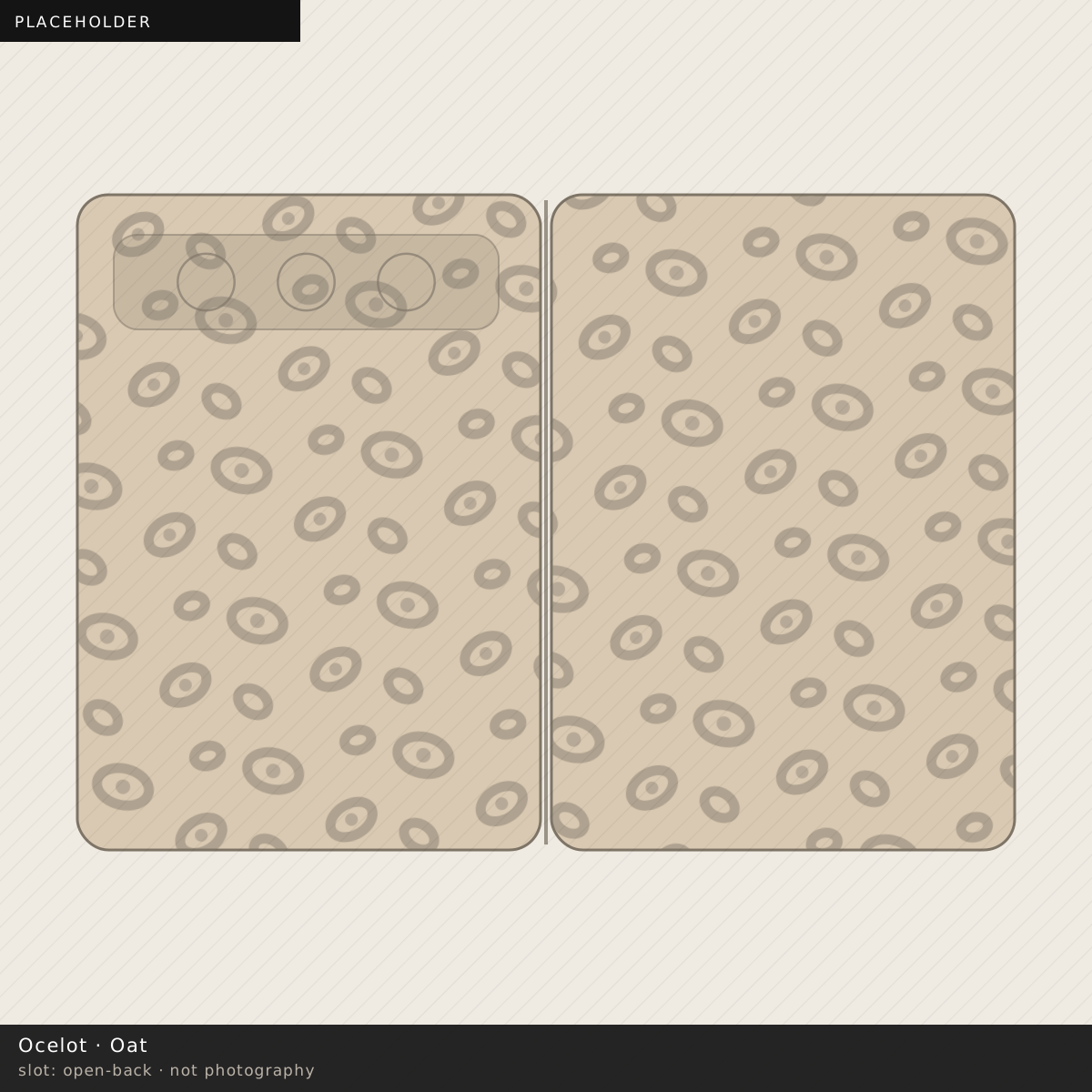
A print on a normal phone is one surface seen one way. A print on a folding phone has three states: closed, where you see one panel; opening, where the two halves separate; and open, where they are a single wide field. A pattern can be designed for that. A repeating print carries across the fold without being asked. A large single motif has to be positioned — put a peony in the centre of the back and the hinge runs through it.
The most satisfying version is a drawing that uses the fold. A single continuous line that starts on one panel and finishes on the other is one object when the phone is open and two fragments when it is closed. Stone veneer does the same thing: cut both panels from one virtual slab, the way a cabinetmaker book-matches a door, and the banding lines up when it opens and stops cleanly when it shuts.
The part that is genuinely hard
Not the shells. Moulding two shells to a tolerance is ordinary work.
The hard part is the fit at the inner edge — the long edge of each shell that runs alongside the hinge. It has to come close enough to the hinge to hold the shell on and to leave no gap for dust, and stop far enough short to never touch. That is a tolerance measured in tenths of a millimetre on an edge that is 160mm long and has to stay straight after the part cools.
It is also the edge nobody photographs, which is a reasonable heuristic for which cases have been engineered and which have been styled.
What happens at the corners
The corner is where a case earns its money and it is the hardest thing to get right on a folding phone, because there are eight of them rather than four, and four of them sit next to a hinge.
On a rigid phone a corner can be thickened freely. Nobody notices an extra half millimetre at a corner and it absorbs most of the energy of a drop, which is why every protective case is fattest there. On a folding phone the two inner corners — the ones adjacent to the hinge — cannot be thickened at all, because whatever is added there is exactly what prevents the phone closing.
So the protection is asymmetric by necessity. The four outer corners can be built up. The four inner ones have the shell thickness and nothing more, and a case that claims uniform corner protection on a folding phone has either not understood the problem or is describing a case that does not close.
A related consequence: a folding phone dropped on an inner corner while open is the worst case, and there is no case design that solves it. It is worth knowing rather than being sold a promise about it.
How to read a product page for one of these
Four things tell you whether a folding case was engineered or adapted.
Does the photography show it open? A case shot only closed is a case photographed the way a rigid phone is photographed. The open shot is the one that reveals whether it is two parts and how the inner edges are finished.
Is there a macro of the hinge area? This is the shot that is hardest to fake and easiest to skip. Its absence is not proof of anything; its presence is a reasonable signal.
Does it say which half has the magnets? On a phone with two backs that is a real question, and a page that does not answer it probably has not asked it.
Are the cutouts described, or shown? A drawing with the cutouts called out takes effort that a stock render does not.
What we do not publish
We do not state a thickness, a weight or a drop rating anywhere on this site.
Those are claims about a moulded part, and the honest source for them is a caliper and a scale applied to a production sample — not a CAD model, and not a number from a supplier’s spec sheet. When a sample has been measured, the figures go up with the date they were taken. Until then a number would be a hope with a decimal point.
Every competitor quotes a thickness. That is not evidence that theirs is measured.
This article explains a mechanism from first principles. It cites no external sources because it makes no external factual claims — every statement above follows from the geometry of a hinged object, and where a claim would need a measurement to support it, the article says that the measurement has not been taken.